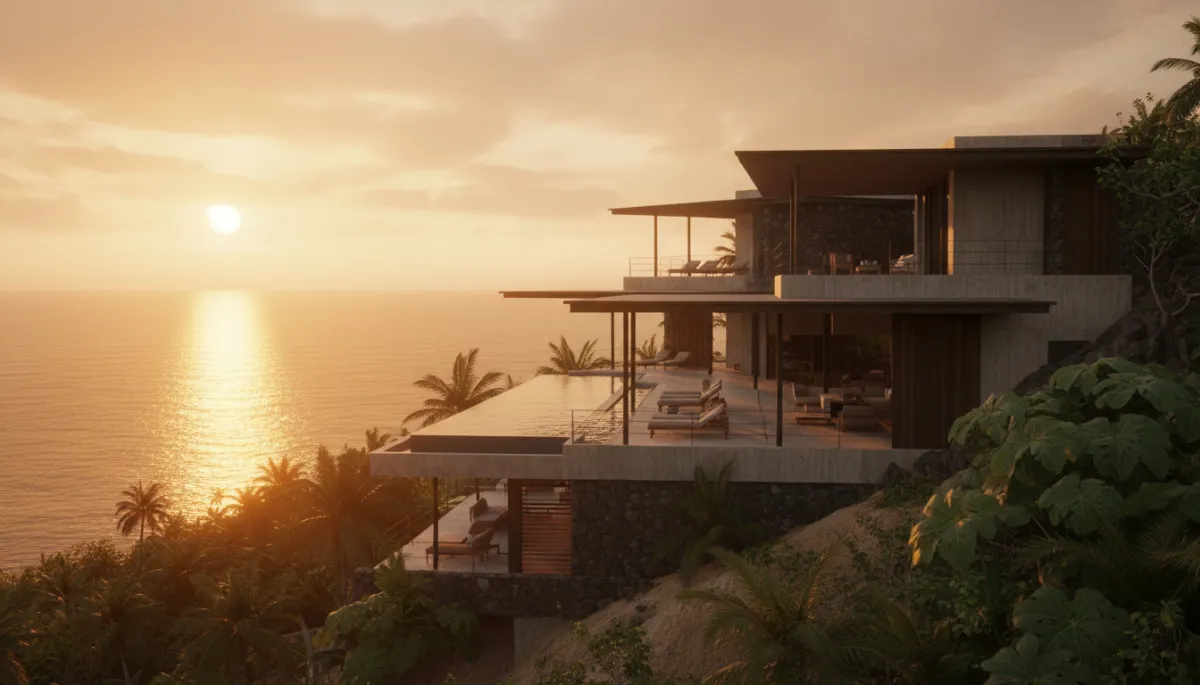
Designing for the Oaxacan Coast: Land and Sea
Architecture, Oaxaca Coastal Architecture, Pacific Mexico Architecture
Between Land and Sea: Designing for the Oaxacan Coast
On the Pacific edge of Oaxaca, architecture is less a constructed object than a negotiated truce between sun, salt, wind and time. For Belo-Design, every project along this coast is both a technical exercise and a love letter to a landscape that refuses to be tamed.
A Town Written in Light, Salt and Sound
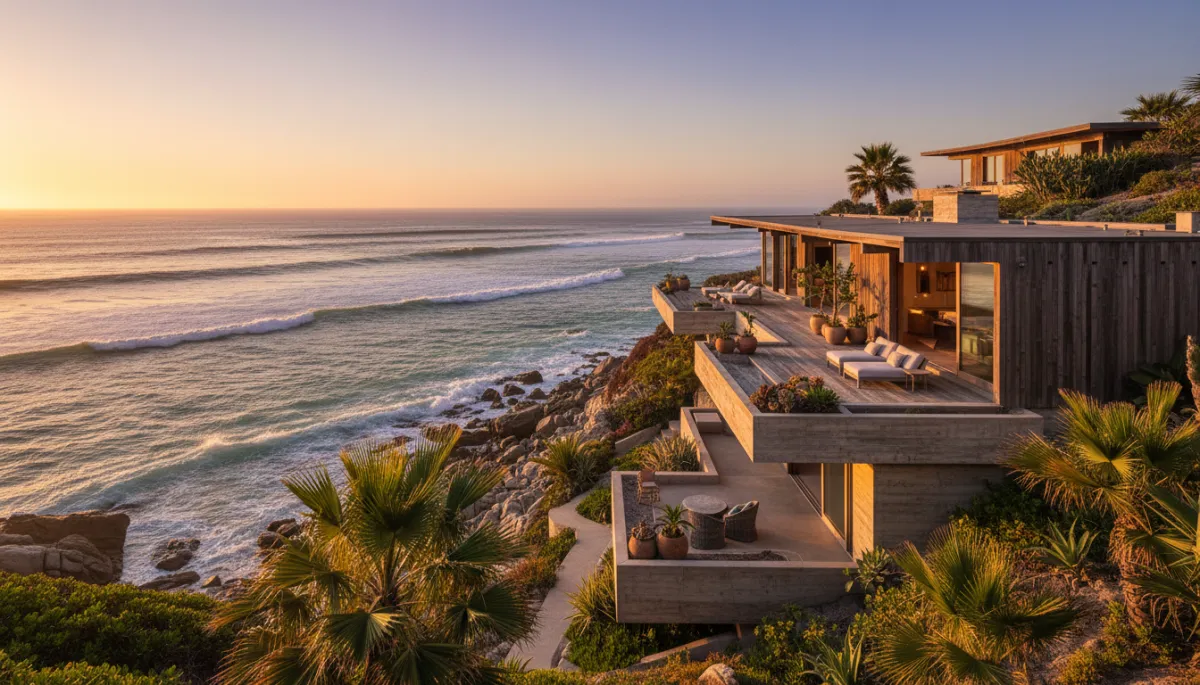
Puerto Escondido does not reveal itself all at once. It arrives slowly, in the weight of the air as you step from an airplane or a car, in the way the Pacific light hits your skin like a warm hand. The humidity here is not a passing condition; it is the medium through which everything is seen and felt. At midday, the sky is a hard, enamel blue, the kind that makes shadows razor-sharp and colors impossibly saturated. By late afternoon, that same light softens, slipping into gold, turning concrete honey-toned and the sea a deep, cinematic indigo.
The soundtrack is constant surf, a low, muscular roar that rises and falls against the rocky points and long beaches that define this stretch of Pacific Mexico architecture. There is the smell of salt and copal smoke, of grilled fish and ripe mango from a roadside stand. In the streets, you hear Zapotec and Spanish, the clipped consonants of French and German, the easy English of surfers and digital nomads. Puerto Escondido luxury homes share the horizon with simple block houses, palapa-roofed fondas, and beach shacks that have stood, improbably, for decades. This is not a resort town polished into anonymity; it is a place of character, layered and specific, where architecture must learn to listen before it speaks.
Designing in Negotiation with Nature
Along this coast, every design decision is an argument with the elements. The sun is not merely bright; it is relentless. Roofs and terraces must contend with a vertical light that can bleach fabric and crack finishes in a single season. Deep overhangs and covered outdoor rooms become less aesthetic gesture and more survival strategy, allowing tropical home design to filter light rather than fight it. To practice sustainable coastal design here is to understand that shade is the most precious material of all.
Then there is the salt. Invisible, omnipresent, it rides the breeze, settling on railings, hinges, exposed metalwork. Beachfront architecture Mexico must anticipate corrosion from the first sketch: stainless steel specified carefully, hardware minimized or concealed, joinery designed to be inspected, serviced, replaced. Concrete, that most modern of materials, becomes an ally when detailed with care, its mass both shield and anchor against wind and water. The ground itself is rarely flat; sites tumble toward the sea, cut with ravines and rocky outcrops. Irregular topography demands a choreography of levels, platforms and stairs, each one calibrated to catch a view without blocking a breeze or destabilizing the slope.
Add to this the quiet, ever-present fact of seismic activity. Structural systems must be both robust and forgiving, able to flex and absorb movement without losing their composure. For Belo-Design, tropical home design in this region is an exercise in resilience: frames that can sway, walls that can breathe, details that accept hairline cracks as part of the story rather than a flaw to be erased.
A Coastal Vocabulary: Shade, Mass and Air
Over time, a distinct vocabulary of Oaxaca coastal architecture has emerged, shaped by climate, culture and material. Open-plan living is the default, not the exception: living, dining and kitchen spaces slide into one another, often without conventional walls, defined instead by level changes, columns and the direction of the breeze. Covered terraces extend these social rooms outward, offering generous, shaded platforms where the day can unfold between hammock, pool and sea.
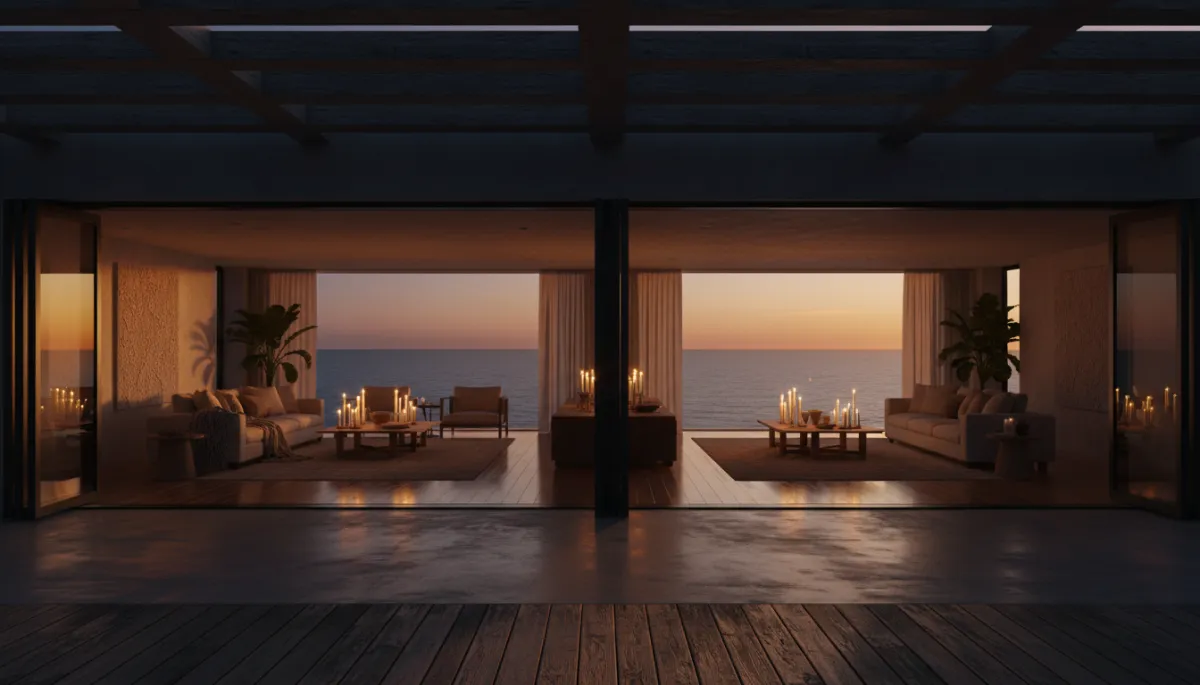
Moody interior at dusk showing a shaded concrete and timber terrace opening seamlessly to a...
Deep roof overhangs are drawn long and low, casting protective shadows that cool walls and glazing without enclosing space. Thermal mass is enlisted as quiet technology: thick masonry and concrete store the day’s heat, releasing it slowly as the night breeze arrives. Natural ventilation strategies are almost invisible but meticulously calculated—aligned openings, operable screens, clerestory slits that invite hot air to rise and escape. In this way, indoor outdoor living Mexico becomes a form of passive engineering, reducing reliance on mechanical cooling while keeping rooms habitable and sensuous year-round.
Materials, too, speak of place. Local stone, rough and mineral, grounds the architecture in the hillside. Tropical hardwoods weather gracefully, silvering in the sun, their grain echoing the striations of nearby cliffs. Against these, smooth planes of cast-in-place concrete feel almost like carved earth. The result is beachfront architecture Mexico that feels both contemporary and deeply rooted, as if it had grown from the site rather than arrived by container ship.
Dissolving the Boundary Between Inside and Out
Along this coast, the line between interior and exterior is not a wall but a gradient. For Belo-Design, indoor-outdoor living is not an added amenity; it is the organizing principle around which everything else is arranged. Bedrooms open onto private gardens where morning showers are taken beneath the sky. Kitchens spill out to outdoor dining rooms, where a ceiling fan turns lazily above a long table, and the smell of mezcal and lime mingles with sea spray. Pools are drawn close to living spaces, becoming reflecting surfaces for sunset and moonlight alike.
Sliding screens of wood or woven fiber stand in for solid partitions, modulating privacy, light and wind. At certain hours, the house feels almost entirely open, a series of platforms and roofs drifting between jungle and sea. At others, it can be made intimate, filtered, cocooned from the elements without ever losing the sound of the surf. In the context of Oaxaca real estate, this way of living is a quiet luxury: less about spectacle, more about the daily pleasure of moving through air, shadow and view with ease.
Culture as Foundation, Not Decoration
To design in Oaxaca is to work in a place that is anything but a blank canvas. Zapotec heritage and pre-Hispanic craft traditions are not museum artifacts; they are living, evolving practices woven into everyday life. Textiles from the Sierra arrive in saturated reds and indigos, their patterns carrying stories of mountains, rivers and constellations. Pottery from nearby villages brings earth tones and tactile imperfection to otherwise minimal spaces. For Belo-Design, these are not exotic touches, but collaborators in the creation of a home.
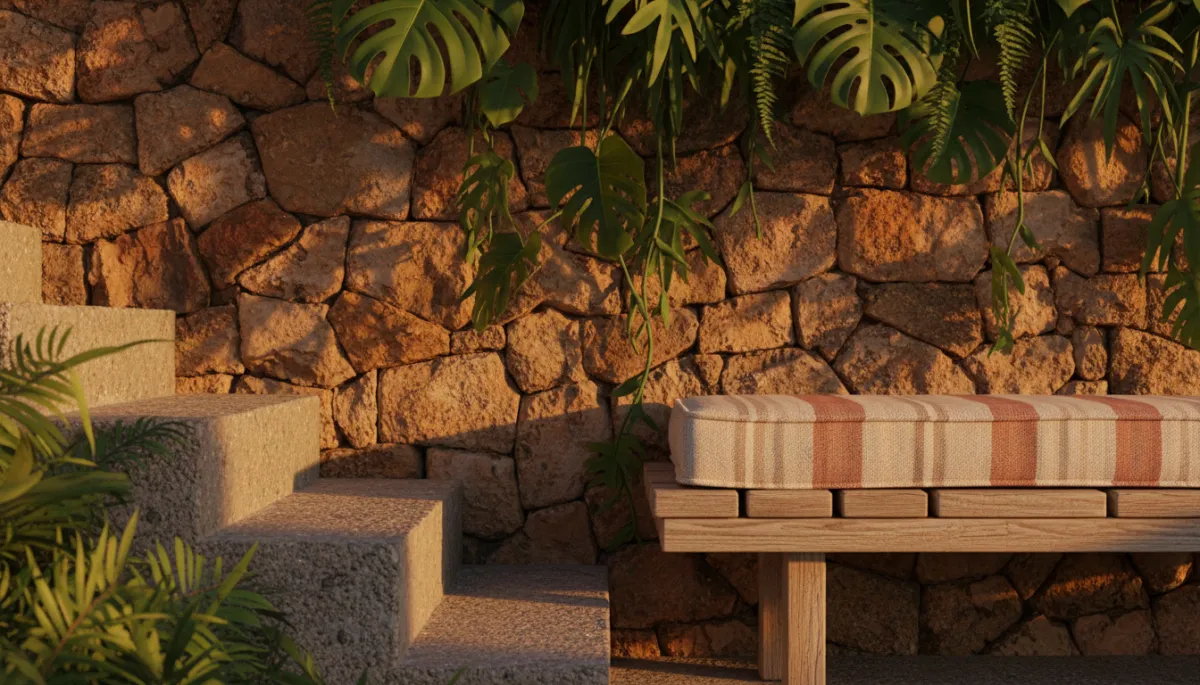
Close-up detail of a concrete stair meeting a wall of hand-laid local stone, lush tropical...
Responsible design in Oaxaca means understanding when to step back. It is a refusal to impose an imported aesthetic that erases what is already here. Instead, Pacific Mexico architecture can amplify local voices: commissioning carpenters who know how wood behaves in this humidity, collaborating with weavers whose patterns subtly inform façade screens, aligning courtyards with existing trees rather than clearing them. In the realm of luxury beach homes Mexico, true sophistication lies in this kind of quiet, site-responsive architecture—one that honors the region rather than attempting to colonize it with a glossy, placeless language.
Building as an Act of Commitment
To build a home on the Oaxacan coast is to make a promise to a landscape that will outlast you. The sea will continue its slow work on the cliffs; the palms will grow, lean, fall and seed themselves again. Storms will come, as they always have, re-drawing beaches and carving new lines into the rock. Against this backdrop, architecture is both fragile and enduring—a brief arrangement of materials that, if designed with care, can age gracefully into the scenery rather than fight against it.
For Belo-Design, sustainable coastal design here is as much about attitude as technology. It is about specifying durable materials and simple systems, yes, but also about accepting patina, celebrating weathering, designing for maintenance rather than pretending it will never be needed. It is an architecture that acknowledges its own impermanence and, in doing so, becomes more humane. For clients exploring Puerto Escondido luxury homes, this perspective offers something rarer than a panoramic view: the chance to inhabit a place with humility, to live between land and sea not as owner, but as attentive guest.
In the end, design in Oaxaca is an invitation—to wake with the first light on the water, to feel the evening breeze slide through open rooms, to understand that the true luxury of this coast is not its isolation, but its profound sense of belonging. The house is a frame; the real project is the life that unfolds within it, carried by the sound of surf and the slow, golden drift of Pacific light.
