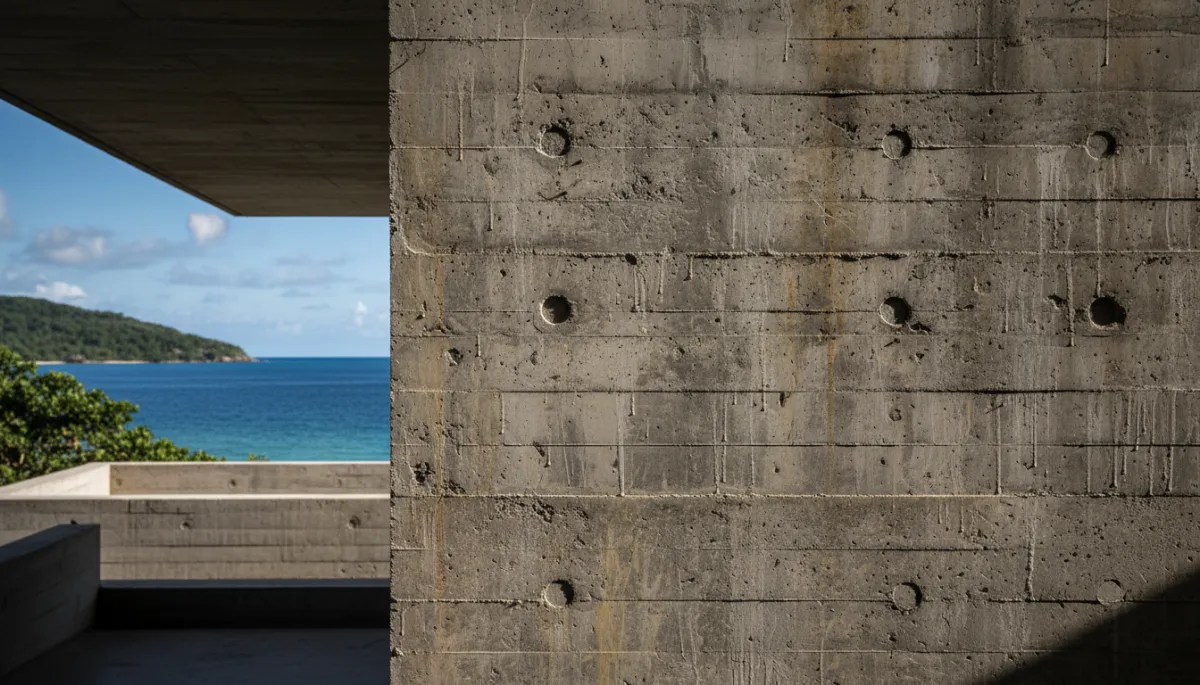
The Honesty of Concrete in Modern Architecture
Architecture, Materiality, Concrete
The Honesty of Concrete: Material Truth in Modern Architecture
Concrete has been called brutal, cold, even inhuman. Yet in the right hands, it becomes one of the most expressive and sincere instruments in contemporary home design and civic architecture — a material that neither flatters nor deceives, but simply tells the truth of how a building is made.
Honest Architecture and the Case for Material Truth
Honest architecture begins with a simple conviction: a building should not pretend to be something it is not. Structure should read as structure. Surfaces should not disguise their origins behind imitation veneers. This is not an aesthetic fad but an ethical position about how we live with the built world. When we speak of architectural materiality, we are really speaking of this pact between the building and its inhabitants — the promise that what you touch, see, and inhabit corresponds to how the building truly stands.
Concrete is uniquely suited to this notion of honest architecture. It does not rely on illusion. It cannot convincingly masquerade as stone, timber, or steel without losing its integrity. When left as exposed concrete, it reveals the imprint of its making: the grain of the formwork, the rhythm of tie holes, the slight variations where mixture, weather, and human hands have intervened. In an age saturated with smooth digital surfaces, this raw material design feels almost radical in its candor.
The Paradox of Concrete: Primal and Modern at Once
Concrete is a paradox. At its core, it is primal — sand, stone, water, and binder, mixed and poured like an ancient ritual. Yet it is also one of the most modern materials in our repertoire, capable of spanning vast distances, forming impossibly thin shells, and supporting daring cantilevers that seem to defy gravity. This duality is what makes concrete architecture so compelling: it is both earthbound and futuristic, weighty and abstract.
Texture is where this paradox becomes tactile. Run your hand along a carefully cast wall and you feel the memory of the formwork — the boards or panels that once held the liquid mass. The surface may be silky, almost stone-like, or softly pitted, recording air bubbles and slight inconsistencies. Light glides across these planes, catching edges, deepening shadows, dramatizing every joint. Concrete’s notorious “weight” becomes a visual anchor, grounding spaces with a sense of calm permanence that lighter, more fragile materials cannot achieve.
Lineage of Masters: From Béton Brut to Meditative Minimalism
The story of concrete’s rehabilitation as a noble material begins with the modern masters. Le Corbusier’s béton brut — literally “raw concrete” — rejected smooth, polite finishes in favor of surfaces that wore their making openly. His late works, from the Unité d’Habitation to the monastery of La Tourette, showed how rough concrete could carry an almost spiritual gravity, its imperfections reading as evidence of human labor rather than flaws to be concealed.
Later, the Tadao Ando influence redefined what exposed concrete could be. In Ando’s work, the material is sharpened to an almost impossible precision: form-tie grids like a quiet score, edges so crisp they seem drawn with a blade of light. His buildings demonstrate that material beauty in architecture can emerge from restraint — from a single, consistent material tuned to perfection, allowing light, shadow, and proportion to do the expressive work. Where Corbusier’s concrete is rough and heroic, Ando’s is meditative, an architecture of silence and reflection.
In parallel, Luis Barragán demonstrated how concrete could belong to place. In his modern Mexican architecture, raw walls meet saturated color, water, and blinding sunlight. Concrete becomes the quiet, massive counterpoint to vivid planes of pink, yellow, or cobalt. It is both backdrop and protagonist, catching light, holding shadow, and framing sky. Barragán’s lesson is clear: concrete is not inherently gray or austere; it is a canvas for atmosphere, emotion, and landscape.
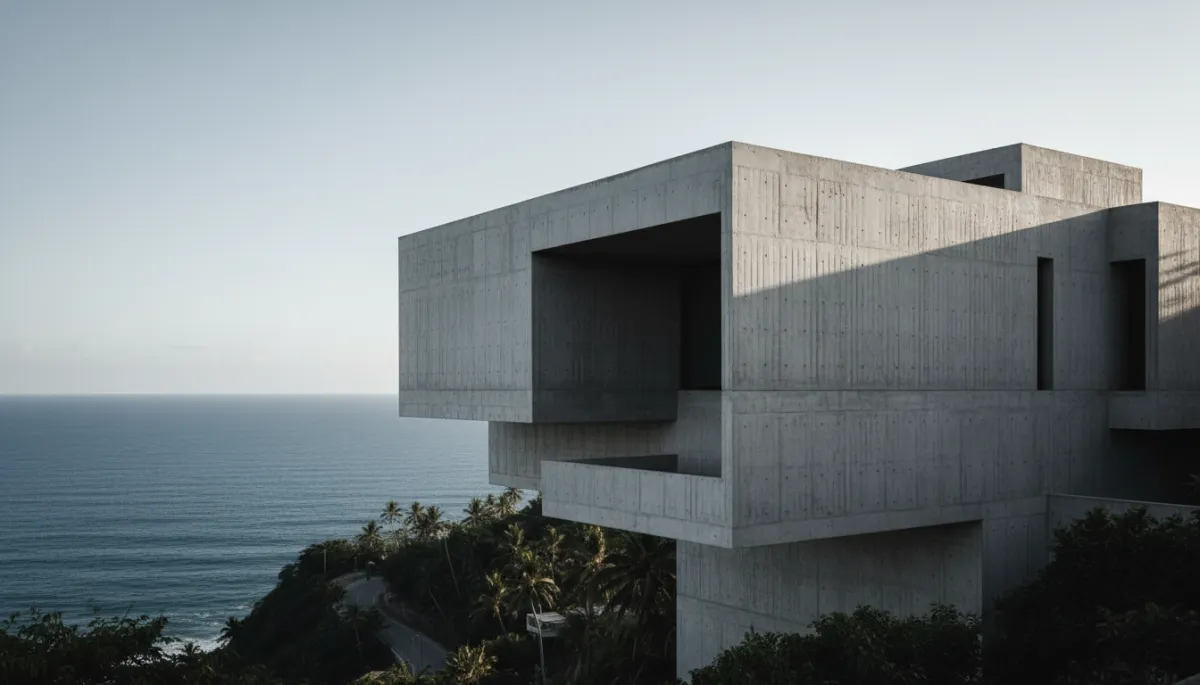
In tropical light, exposed concrete becomes a living register of sun, shadow, and salt air.
Concrete in the Tropics: Light, Weather, and Coastal Air
In a tropical context, concrete takes on yet another character. Under the equatorial sun of Oaxaca or along the Pacific coast, light is not gentle; it is sharp, almost architectural in its own right. Here, concrete’s density and thermal mass are allies. Thick walls buffer heat, deep overhangs carve shade, and cool interior courtyards become refuges carved from solid mass. The play of light and shadow across exposed concrete surfaces is amplified, turning every day into a quiet performance of changing angles and intensities.
Salt air, humidity, and time do not simply attack concrete; they collaborate with it. Surfaces soften, tones deepen from pale gray to warm stone-like hues, edges lose their initial severity. Hairline cracks, faint stains, and patches of patina do not signal decay so much as character. In this climate, concrete does not aspire to remain pristine. Instead, it settles into the landscape, weathering into a calm, dignified presence that feels increasingly at home with each passing season.
The Belo-Design Perspective: Concrete as Commitment
At Belo-Design, we see concrete not as a compromise, but as a declaration. Choosing concrete in contemporary home design is an act of confidence — in the form, in the proportions, and in the life the building will lead long after the scaffolding is gone. Unlike finishes that can be endlessly replaced or disguised, concrete is unforgiving. Once poured, it records every decision with absolute clarity. This is precisely its power: concrete doesn’t lie.
Working with concrete means designing from the inside out and the outside in simultaneously. Wall thickness, span, opening, and joint are not afterthoughts; they are the architecture itself. Our approach to raw material design embraces this inevitability. We choreograph how light will slide across a stairwell wall at dusk, how a shaded terrace will feel under bare feet at noon, how the sound of rain will resonate against a courtyard façade. In this sense, concrete is not merely structural; it is atmospheric, sensory, and deeply human.
On Permanence: Building Beyond a Lifetime
To build in concrete is to accept a certain gravity of intention. These structures are conceived to outlast their builders, to hold their ground as families, neighborhoods, and cities evolve around them. This is not a burden; it is the point. In a culture accustomed to rapid obsolescence, a concrete building offers an alternative timeline — one measured in decades and generations rather than styles and seasons.
When we speak of material beauty in architecture, we are not talking about surface perfection but about depth of presence. A well-designed concrete house on the Oaxacan coast, or a quiet urban retreat in the city, gathers memory in its pores. It bears the trace of children’s hands on a courtyard wall, the shadow of a beloved tree growing taller each year, the subtle darkening where rain finds its habitual path. This is the quiet triumph of concrete architecture: it remains, it records, it endures — an honest companion to the lives unfolding within and around it.
